FTSE Finish Line: August 13 — Miners Drag FTSE to Two-Week Low Despite Stronger UK GDP
FTSE Finish Line: August 13 — Miners Drag FTSE to Two-Week Low Despite Stronger UK GDP
London’s FTSE 100 fell to a more than two-week low on Thursday as a sharp sell-off in miners overwhelmed relief from stronger-than-expected UK economic growth. The benchmark was hit by Antofagasta’s downbeat copper production forecast, weaker metal prices, a firmer dollar and renewed concerns that energy-driven inflation pressures could persist while the Middle East conflict remains unresolved.
Antofagasta was the clearest drag, falling 5% after cutting its 2026 copper output forecast because of a July shutdown at its Los Pelambres mine. The update landed badly because miners had been one of the FTSE’s main supports during recent sessions, benefiting from global risk appetite, commodity demand hopes and geopolitical hedging. A company-specific production cut quickly turned into a sector-wide setback.
The selling spread across the mining complex. Rio Tinto dropped 4.5%, while Anglo American fell 3.2%. The FTSE 350 industrial metal miners index and precious metal miners index both lost more than 3% as metal prices softened against a stronger dollar. That removed one of the most important pillars of recent FTSE resilience.
The move was particularly damaging because mining strength had helped offset weakness in consumer, healthcare and financial stocks earlier in the week. When both industrial and precious metal miners fall at the same time, the FTSE 100 is exposed because of the sector’s index weight and its role as a global cyclical barometer.
The stronger dollar added pressure by making dollar-priced metals less attractive to non-dollar buyers and tightening global financial conditions at the margin. That effect partly offset the relief from Wednesday’s tame U.S. inflation reading, which reduced expectations of a Federal Reserve rate hike next month. Lower Fed hike risk would normally help risk assets, but the commodity complex was more focused on dollar strength and sector-specific disappointments.
The U.S. inflation reading helped global rate sentiment, but it did not remove the UK market’s main worry: energy. A lack of progress toward a permanent end to the Middle East conflict kept oil prices supported and sustained concerns about energy-driven inflationary pressure. The Strait of Hormuz remains the market’s central geopolitical fault line, with investors repeatedly shifting between optimism over reopening prospects and concern that negotiations are becoming more complicated.
That unresolved energy risk matters directly for the Bank of England. The BoE’s recent message has been that domestic disinflation can offset external energy pressure, allowing Bank Rate to remain on hold at 3.75%. But oil remaining firm, alongside signs of stronger pay growth in recent labour-market surveys, means markets are no longer fully relaxed about that stance.
At the same time, Thursday’s GDP data gave the BoE a more resilient growth picture to consider. The UK economy grew 0.4% quarter-on-quarter in the second quarter, stronger than the Bank’s 0.3% forecast in the Monetary Policy Report. That followed a stronger-than-expected 0.6% expansion in the first quarter, suggesting the economy has carried more momentum into 2026 than policymakers expected.
The details were constructive. Household consumption grew 0.3% quarter-on-quarter. That was slower than the 0.6% pace recorded in the first quarter, but still stronger than the quarterly growth rates seen during 2025. This suggests households are not booming, but they are more resilient than feared despite energy uncertainty, high rates and uneven retail data.
Business investment also grew for a second consecutive quarter, adding to the sense that companies are still spending despite geopolitical headwinds and a difficult cost backdrop. That is an encouraging signal for medium-term productivity and corporate confidence, particularly after recent construction and manufacturing indicators pointed to only partial stabilisation.
Government consumption fell slightly, likely reflecting June school closures during the heatwave, while net exports made a neutral contribution to growth. The absence of a drag from net trade was helpful, especially given the global disruption caused by the Middle East conflict and fluctuating energy prices.
The stronger GDP print complicates the BoE outlook. On one hand, a resilient economy reduces recession risk and supports corporate earnings. On the other, it gives policymakers less reason to dismiss inflation risks if oil and wages remain firm. Markets had already been pricing a meaningful probability of a December rate hike, and better growth data may prevent those expectations from fading too quickly.
The quantitative tightening outlook also stayed in focus. The BoE is expected to vote at its September MPC meeting for £50 billion of QT over the next year, based on concentrated survey expectations. That would likely comprise around £30 billion of passive QT and £20 billion of active gilt sales, again skewed away from long-maturity gilt sales.
The risks are seen to the upside because repo operations may allow the Bank to change the composition of its balance sheet without reducing its overall size as aggressively. For markets, the key issue is whether QT adds pressure to gilt yields at a time when fiscal credibility, inflation risk and energy volatility are already under scrutiny.
A QT programme skewed away from long-gilt sales would be designed to limit disruption at the long end of the curve. That matters because long yields are central to mortgage pricing, pension funds, housebuilders, real estate and broader equity valuation. Still, even a well-telegraphed £50 billion QT plan can affect market liquidity and risk appetite.
The mid-cap space provided some brighter spots. Costain gained 4.6% after the infrastructure solutions firm issued upbeat half-year results. The move showed that investors remain willing to reward companies with clear earnings delivery, especially in infrastructure-related areas that may benefit from public and private investment demand.
Savills surged 8.7% after reporting a 47% rise in half-year underlying profit, helped by improvement in its North American and transactional businesses. The rally was notable because property and real-estate-adjacent names have been under pressure from rate uncertainty. Savills’ results suggested transactional activity is recovering in key markets, giving investors a strong company-specific reason to buy.
Savills’ strength also contrasted with the weakness in broader property and rate-sensitive names earlier in the week. It reinforced a theme running through this earnings season: macro concerns matter, but companies that deliver visible profit improvement can still outperform sharply.
The problem for the FTSE 100 was that these mid-cap gains were not enough to offset the drag from heavyweight miners. Antofagasta, Rio Tinto and Anglo American collectively pulled the benchmark lower, and the fall in both industrial and precious metal mining indexes showed that the sell-off was sector-wide rather than isolated.
Consumer and domestic sentiment also remain uneven. Earlier this week, British Retail Consortium data showed like-for-like retail sales rose only 1% year-on-year in July, below expectations and the slowest pace since February. While the GDP numbers show households are still spending, the retail data suggest the recovery is not broad or effortless. Higher energy costs could still squeeze discretionary demand.
Prime Minister Andy Burnham’s government will likely welcome the stronger GDP data, especially the resilience in household consumption and business investment. But the “difficult financial outlook” he acknowledged remains relevant. Stronger growth improves fiscal arithmetic at the margin, but any attempt to lower business costs must still be carefully designed to avoid unsettling gilt markets or adding to inflationary pressure.
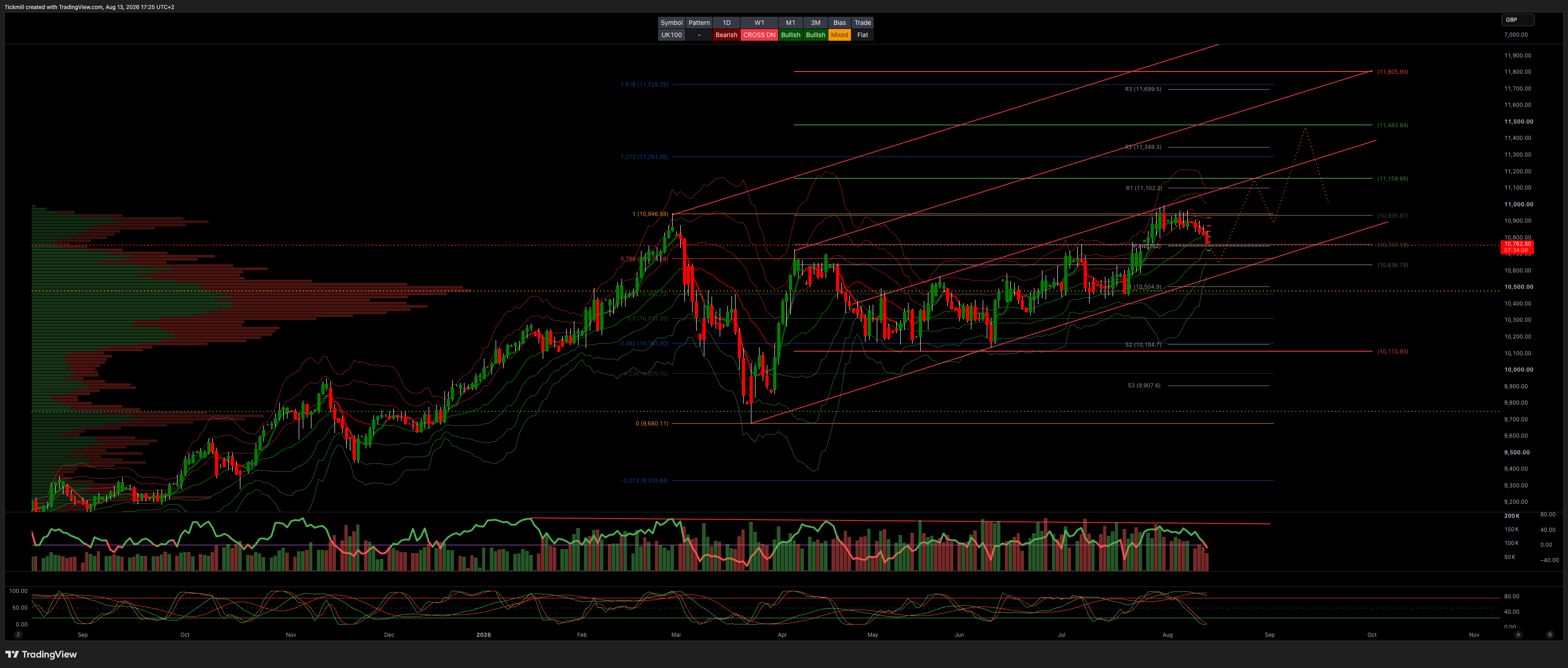
Finish Line: The FTSE 100 fell to a more than two-week low as Antofagasta dropped 5% after cutting its 2026 copper output forecast, dragging Rio Tinto, Anglo American and the wider mining sector lower. Industrial and precious metal miners both lost more than 3% as metal prices weakened against a firmer dollar. Stronger UK GDP failed to rescue the benchmark: the economy grew 0.4% in Q2, above the BoE’s 0.3% forecast, led by household consumption and business investment. The data confirm resilience, but also complicate the rate outlook while oil remains supported by unresolved Middle East risks. With the BoE expected to vote for around £50 billion of QT in September, the market’s message was cautious: growth is holding up, but miners are wobbling, energy inflation risk persists, and policy support is not guaranteed.
TECHNICAL & TRADE VIEW – FTSE100
Daily VWAP Bearish
Weekly VWAP Bullish>Bearish
Above 10700 Target 11150
Below 10400 Target 9500
Disclaimer: The material provided is for information purposes only and should not be considered as investment advice. The views, information, or opinions expressed in the text belong solely to the author, and not to the author’s employer, organization, committee or other group or individual or company.
Past performance is not indicative of future results.
High Risk Warning: CFDs are complex instruments and come with a high risk of losing money rapidly due to leverage. 69% and 73% of retail investor accounts lose money when trading CFDs with Tickmill UK Ltd and Tickmill Europe Ltd respectively. You should consider whether you understand how CFDs work and whether you can afford to take the high risk of losing your money.
Futures and Options: Trading futures and options on margin carries a high degree of risk and may result in losses exceeding your initial investment. These products are not suitable for all investors. Ensure you fully understand the risks and take appropriate care to manage your risk.
Patrick has been involved in the financial markets for well over a decade as a self-educated professional trader and money manager. Flitting between the roles of market commentator, analyst and mentor, Patrick has improved the technical skills and psychological stance of literally hundreds of traders – coaching them to become savvy market operators!